Amazon MCF vs FBA fees in 2026
"MCF costs 30-50% more than FBA" is the line everyone repeats. Against Amazon's official 2026 rate card it's wrong in both directions: the same 1.5 lb product runs 96% more expensive as a single-unit order and 3% cheaper at four units. Here's the real math, including the referral fee you stop paying — and the free calculator to run it on your own product.
Search for Amazon MCF pricing and you'll meet the same sentence everywhere: multi-channel fulfillment costs 30 to 50 percent more than FBA. It's repeated so often it reads like settled fact.
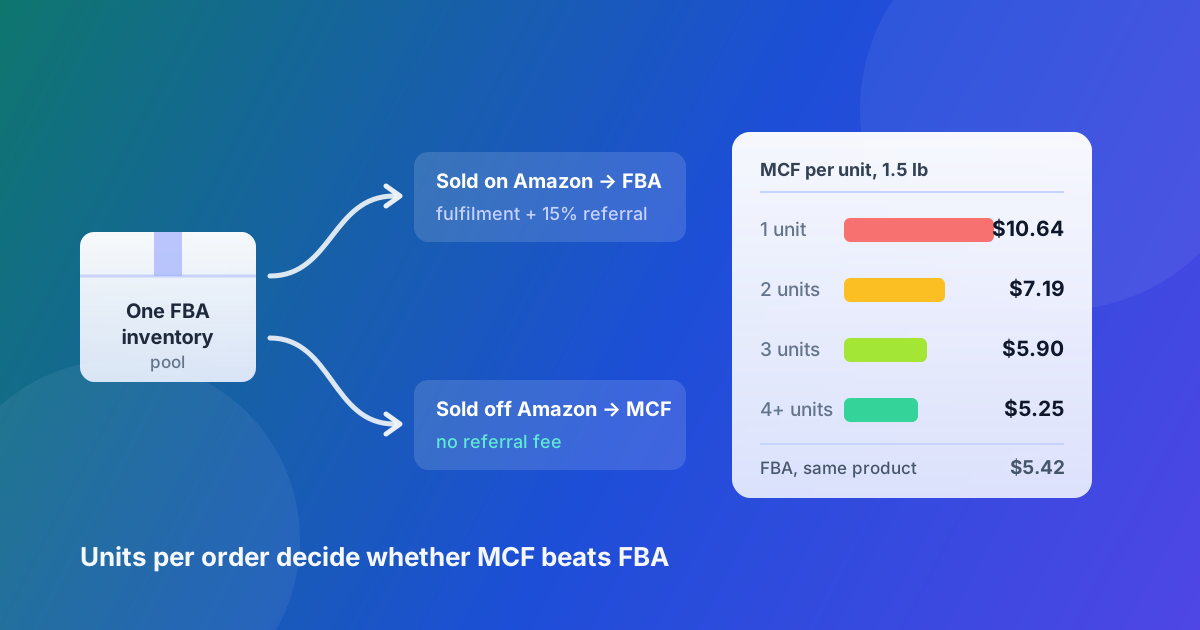
Checked against Amazon's official 2026 rate card, it's wrong in both directions. Take one large standard product at 1.5 lb and change nothing but the number of units in the order:
| Units in the order | MCF fee | FBA fee | Difference |
|---|---|---|---|
| 1 unit | $10.64 | $5.42 | +96% |
| 2 units | $7.19 | $5.42 | +33% |
| 3 units | $5.90 | $5.42 | +9% |
| 4+ units | $5.25 | $5.42 | -3% (cheaper) |
The real spread is -3% to +96%. Every guide quotes the single-unit rate, because units per order is the one pricing axis none of them mention — and it's the one that decides the answer.
What MCF actually is
Multi-Channel Fulfillment has Amazon ship orders placed somewhere else — your Shopify store, eBay, TikTok Shop, a wholesale PO — out of the same FBA inventory you already hold. Same warehouse, same stock, same pickers. Only the order source changes.
That single difference carries the whole economic argument: because the sale didn't happen on Amazon, there is no referral fee. On a $34.99 product in a 15% category, that's $5.25 a unit you simply don't pay. Amazon charges you back through higher fulfillment fees — which is why the comparison is worth doing properly rather than by rule of thumb. If you need the other side of it first, we broke down Amazon FBA fees in the US separately.
How MCF pricing works
Four things set an MCF fee: size tier, shipping weight, delivery speed, and units per order. That last one has no FBA equivalent, and it moves the number more than anything else.
It's worth naming what MCF does *not* price on, because it trips people up coming from FBA:
- Sale price is irrelevant. FBA charges different fees under $10, $10-50, and over $50. MCF has no price bands at all.
- No apparel distinction. FBA runs a separate, higher apparel rate card. MCF has one table per speed.
- Two speeds, not three. Standard is 3 business days, Expedited is 2. Priority was discontinued — new Priority orders bill at the Expedited rate.
One more piece of naming to get straight: MCF with Prime is priced identically to Standard speed. It's a delivery promise you can offer on your own storefront, not a pricing tier. Buy with Prime is a different program on its own rate card, and the two are easy to confuse.
The rate card
Large standard covers most private-label products, so that's the table below — standard speed, non-peak, before the surcharge. Small standard, bulky and extra-large sit on the same card if your product falls outside this tier.
| Shipping weight | 1 unit | 2 units | 3 units | 4+ units |
|---|---|---|---|---|
| 4 oz or less | $7.56 | $5.12 | $4.40 | $4.00 |
| 4-8 oz | $7.72 | $5.23 | $4.49 | $4.08 |
| 8-12 oz | $8.61 | $6.00 | $4.90 | $4.50 |
| 12-16 oz | $8.93 | $6.26 | $5.15 | $4.70 |
| 1-2 lb | $10.64 | $7.19 | $5.90 | $5.25 |
| 2-3 lb | $11.75 | $8.13 | $6.79 | $5.95 |
| 3-20 lb | $11.75 + $0.70/lb | $8.13 + $0.65/lb | $6.79 + $0.63/lb | $5.95 + $0.63/lb |
A 3.5% fuel and logistics surcharge applies on top of every figure here, exactly as it does on FBA. Amazon's published tables are always pre-surcharge, so multiply by 1.035 to get what you'll actually be billed.
The multi-unit discount is the whole game
Read down the 1-2 lb row: $10.64, $7.19, $5.90, $5.25. The per-unit fee halves between a single-unit order and a four-unit one.
So if your store's average order is more than one unit, every MCF quote you've read overstates your cost — by up to 2x. That's the single most useful thing to know before pricing this channel.
One important exception: above 30 lb in the bulky tiers, and for every extra-large item, the multi-unit discount disappears entirely. One rate, regardless of how many units are in the box. If you sell heavy, the rest of this comparison changes shape.
MCF vs FBA: the honest comparison
Fulfillment fees alone don't answer the question, because the two channels charge for different things. Here's the full channel cost on a $34.99 product in a 15% referral category, selling on your own site with payment processing at 2.9% + $0.30:
| FBA on Amazon | MCF 1 unit | MCF 2 units | MCF 4+ units | |
|---|---|---|---|---|
| Fulfillment | $5.61 | $11.01 | $7.44 | $5.43 |
| Referral fee | $5.25 | — | — | — |
| Payment processing | — | $1.31 | $1.31 | $1.31 |
| Total channel cost | $10.86 | $12.33 | $8.76 | $6.75 |
| vs FBA | — | +$1.47 | -$2.10 | -$4.11 |
MCF loses on single-unit orders and wins from the second unit on. At four units it's $4.11 per unit cheaper — a 38% cut in channel cost.
If your orders are genuinely one unit at a time, the question becomes price instead. The referral fee you skip has to cover the fulfillment premium, so there's a threshold:
| Your referral rate | MCF beats FBA above |
|---|---|
| 8% | $112 |
| 15% | $47 |
| 17% | $40 |
One caveat worth stating plainly. This compares two different businesses: a sale on Amazon versus a sale on your own site. It only holds if you actually have both channels and they convert comparably. Amazon's traffic is not free either — you pay for it in referral fees — but traffic you have to generate yourself is a real cost that no fee table captures. Treat this as a cost comparison, not a demand forecast.
The costs that aren't on the rate card
- Return processing. MCF charges a per-unit fee on every return, and unlike FBA's version it isn't limited to certain categories. Large standard 1-2 lb is $4.70. At a 5% return rate that's about $0.24 per unit sold; at 10%, about $0.47.
- Storage. Identical to FBA, on the same shared inventory — so it isn't charged twice.
- Lithium batteries. An extra $0.11 per unit on the base fee.
- Remote area delivery. Orders to Alaska, Hawaii, Guam, Puerto Rico and the US Virgin Islands carry a 100% surcharge for standard-size items and 200% for large bulky and extra-large.
- SIPP. A per-unit credit for shipping in original packaging — a few cents on standard sizes, up to $1.32 on bulky.
- Peak season. October 15 2026 through January 14 2027 runs an entirely separate, higher rate card. Budget for it before Q4.
When MCF is the right call
Worth it when:
- Your average order is more than one unit — this is the big one.
- Your price point is high enough that the skipped referral fee is meaningful.
- You already hold FBA inventory and don't want to run a second stock pool for your own site.
- You want fast, Prime-style delivery on a storefront you control.
Think twice when:
- You ship single units under about $47 at a 15% referral rate.
- Your products are bulky or extra-large over 30 lb, where the multi-unit discount vanishes.
- You run a high return rate — MCF bills you for every one of them.
The honest summary: MCF is not a cheaper version of FBA, and it isn't the expensive trap it's often described as either. It's a channel whose economics turn almost entirely on how many units go in the box. Work that number out for your own catalogue before you price anything — you can run your product through the free FBA calculator to get the Amazon side of the comparison in a few seconds.
Sources
Frequently asked questions
- Is Amazon MCF cheaper than FBA?
- For multi-unit orders, usually yes. On a $34.99 product in a 15% referral category, MCF costs $1.47 more per unit on single-unit orders but $2.10 less at two units and $4.11 less at four. For single-unit orders it only wins above roughly a $47 sale price. MCF charges no referral fee but higher fulfillment fees, so the answer depends on your order size and price point.
- Does Amazon MCF charge a referral fee?
- No. The sale happens off Amazon, so only fulfillment and storage fees apply. That skipped referral fee is the entire economic case for MCF — on a $34.99 product in a 15% category it's $5.25 per unit.
- How much does Amazon MCF cost per order?
- It depends on size tier, shipping weight, delivery speed and units per order. A large standard item at 1.5 lb costs $10.64 as a single-unit standard-speed order and $5.25 per unit at four units, before the 3.5% fuel and logistics surcharge.
- Can I use Amazon MCF for Shopify orders?
- Yes — that's the main use case, along with eBay, TikTok Shop, Walmart and wholesale purchase orders. Amazon fulfills the order from your existing FBA inventory regardless of where the sale happened.
- Does MCF use the same inventory as FBA?
- Yes, it's one shared pool. You don't send separate stock and you aren't charged storage twice — storage fees are identical to FBA.
- What happened to MCF Priority shipping?
- Amazon discontinued it. There are now two domestic speeds: Standard at 3 business days and Expedited at 2. New Priority orders bill at the Expedited rate.