How Much Does Head Shipping Cost? A Real China → US Freight Bill
The Profitlee calculator asks for "head shipping" per unit — and most sellers have no idea what to put. So here's a real shipment of mine: 150 lightweight canvas mitts, China to the US West Coast, the sea-freight rates I was quoted, the volumetric-weight trap that doubled my bill, and how it became about 14 to 21 cents per unit.
Product cost, you know. Sell price, you know. Then you hit head shipping and freeze: what's my inbound freight, per unit? Most people guess, or leave it at zero and quietly overstate their margin.
So instead of hand-waving, let me walk you through a real shipment of mine — 150 lightweight canvas mitts from China to the US West Coast: the exact rates I was quoted, the pricing trick that nearly doubled the bill, and the per-unit number I ended up typing into the calculator.
What "head shipping" actually is
Head shipping — 头程 in Chinese — is the first leg of your product's journey: getting it from the factory in China to its destination in the US, whether that's a prep center, a 3PL, or straight into an Amazon fulfillment center. It's the freight you pay a forwarder, up front, before a single unit sells.
It is not the fulfillment fee Amazon charges to deliver to the buyer — that's a separate, later cost the calculator already models. Head shipping is the calculator's input, asked for per unit, in your marketplace currency (USD for the US).
What I actually paid — China to the US West Coast, by sea
My forwarder quoted three sea-freight speeds, priced in Chinese yuan per kilogram. Faster costs more:
| Sea speed | Rate | Transit time |
|---|---|---|
| Fast | ¥11.4 / kg | ~11 days |
| Standard | ¥8.2 / kg | ~13 days |
| Economy | ¥7.6 / kg | ~14–16 days |
These are a real snapshot for one lane at one moment. Ocean rates swing hard with season, fuel, and container capacity, so don't read them as today's price — read them as how the pricing is structured. The structure is the part that never changes: you pay per kilogram of chargeable weight.
The catch: you don't pay for what your goods weigh
Here's what surprises first-time importers. The forwarder doesn't bill your actual weight. They bill chargeable weight (结算重) — the greater of your actual weight and your volumetric weight:
Volumetric weight (材积重) = length × width × height, in centimeters, divided by 6000.
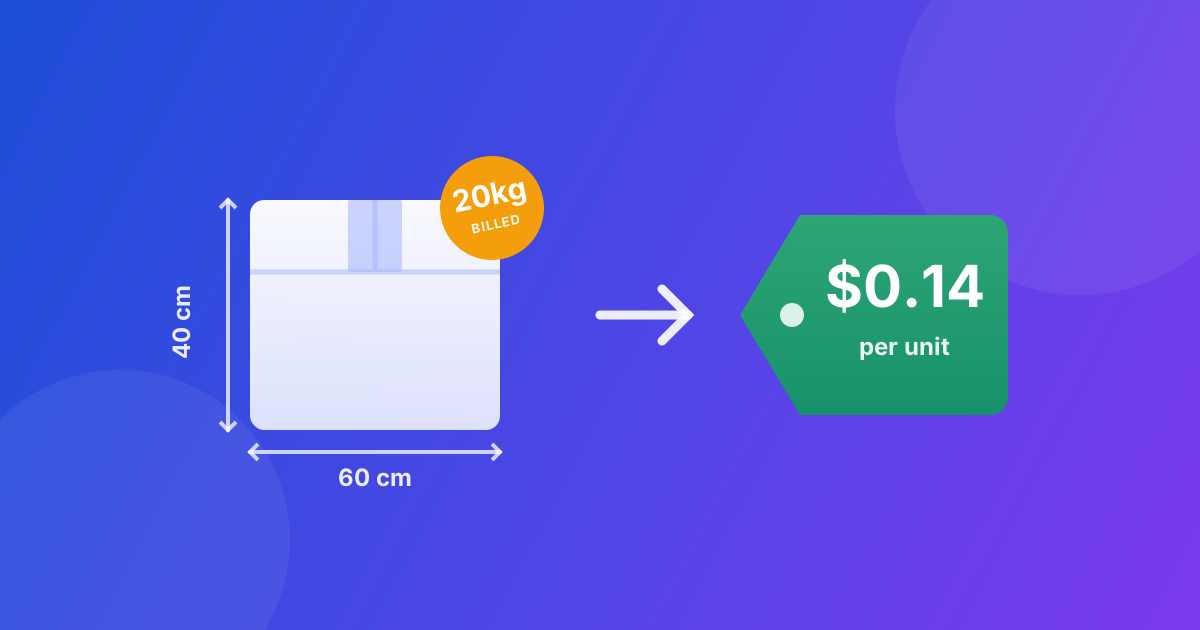
My cartons were 60 × 50 × 40 cm, each holding 9.1 kg of mitts. Run the numbers:
- Volumetric weight = 60 × 50 × 40 ÷ 6000 = 20 kg
- Actual weight = 9.1 kg
- Chargeable weight = the greater of the two = 20 kg
So I paid for 20 kilograms per carton, even though the goods weighed 9.1. Light, bulky products like this are called 抛货 — dimensional, or "dim", cargo. The box sets the price, not the product.
That's about 2.2 times the actual weight. If I'd been billed on the 9.1 kg, freight would have been less than half. This is exactly why packing matters — denser cartons, tighter dimensions, and never air freight for something this light. (My forwarder used the ÷6000 divisor; some carriers and air-express services use ÷5000, which pushes volumetric weight even higher, so always ask which one applies.)
Turning the bill into "head shipping per unit"
Now the useful part — converting a freight quote into the single number the calculator wants. Three steps, using my economy rate:
- Carton freight = chargeable weight × rate. 20 kg × ¥7.6 = ¥152 per carton.
- Convert to USD. ¥152 ÷ 7.2 ≈ $21.10 per carton.
- Divide by units per carton. $21.10 ÷ 150 mitts ≈ $0.14 per unit.
That $0.14 is what goes in the head shipping field. Run it across all three speeds and you get a range:
| Sea speed | Per carton | Per unit (head shipping) |
|---|---|---|
| Fast (¥11.4/kg) | ¥228 ≈ $31.7 | $0.21 |
| Standard (¥8.2/kg) | ¥164 ≈ $22.8 | $0.15 |
| Economy (¥7.6/kg) | ¥152 ≈ $21.1 | $0.14 |
For this product, head shipping lands somewhere around 14 to 21 cents a unit depending on how fast I want it. On a mitt selling for a few dollars, that's a real slice of margin — and exactly the kind of number that decides whether a product is worth doing.
What I'd tell a first-time importer
- Measure your cartons before you ask for a quote. Volumetric weight is set by dimensions, and a slightly smaller box can cut the bill.
- Watch out for light, bulky products (抛货). If volumetric weight beats actual weight, you're paying for air — redesign packaging if you can.
- Trade speed against cash. Economy sea saved me real money per unit; the cost was a few extra days on the water.
- Keep duties separate. Import duty and customs are their own line — the calculator has a separate field for them, so don't fold them into head shipping.
- Get quotes in chargeable weight, and confirm the divisor (÷5000 vs ÷6000) so there are no surprises on the invoice.
Put your real number in
The whole point of knowing your head shipping is that it changes the answer. Once you have a per-unit figure — even a rough one from a single quote like this — drop it into the calculator and watch your net margin adjust. It's usually the difference between a product that looks profitable and one that actually is.
Frequently asked questions
- What's the difference between actual weight and volumetric weight?
- Actual weight is what your goods weigh on a scale. Volumetric weight estimates how much space they take up — length × width × height in centimeters, divided by 6000. Forwarders charge whichever is greater (the "chargeable weight"), because a light but bulky shipment still fills the container.
- Why am I charged for more than my product weighs?
- Because your carton's volumetric weight is higher than its actual weight. My 60×50×40 cm carton held 9.1 kg of goods but had a volumetric weight of 20 kg, so I paid for 20. Light, bulky items like this are called 抛货 (dimensional cargo); denser packing and smaller boxes reduce it.
- Is head shipping the same as the shipping fee Amazon charges?
- No. Head shipping is your inbound freight — factory in China to the destination — paid to a forwarder before you sell anything. Amazon's fulfillment fee is charged later, per order, to deliver to the buyer. The calculator models the two separately.
- Should I ship by sea or by air?
- For a light product like this, sea is dramatically cheaper per unit even after the volumetric penalty; air can cost several times more and is usually only worth it for launch stock or high-value, low-volume goods. This whole example is sea freight.
- How do I enter this in the calculator?
- Convert your carton freight to a per-unit cost in your marketplace currency — chargeable weight × rate, converted to USD, divided by units per carton — and type that into the head shipping field. For my mitts it was about $0.14–$0.21 per unit.