Amazon Brand Registry Documents: Is a Trademark and Product Photo Enough?
I had a pending trademark and a real branded sample, but my application still failed at the invoice step. Here is what I learned about the documents to prepare before applying.
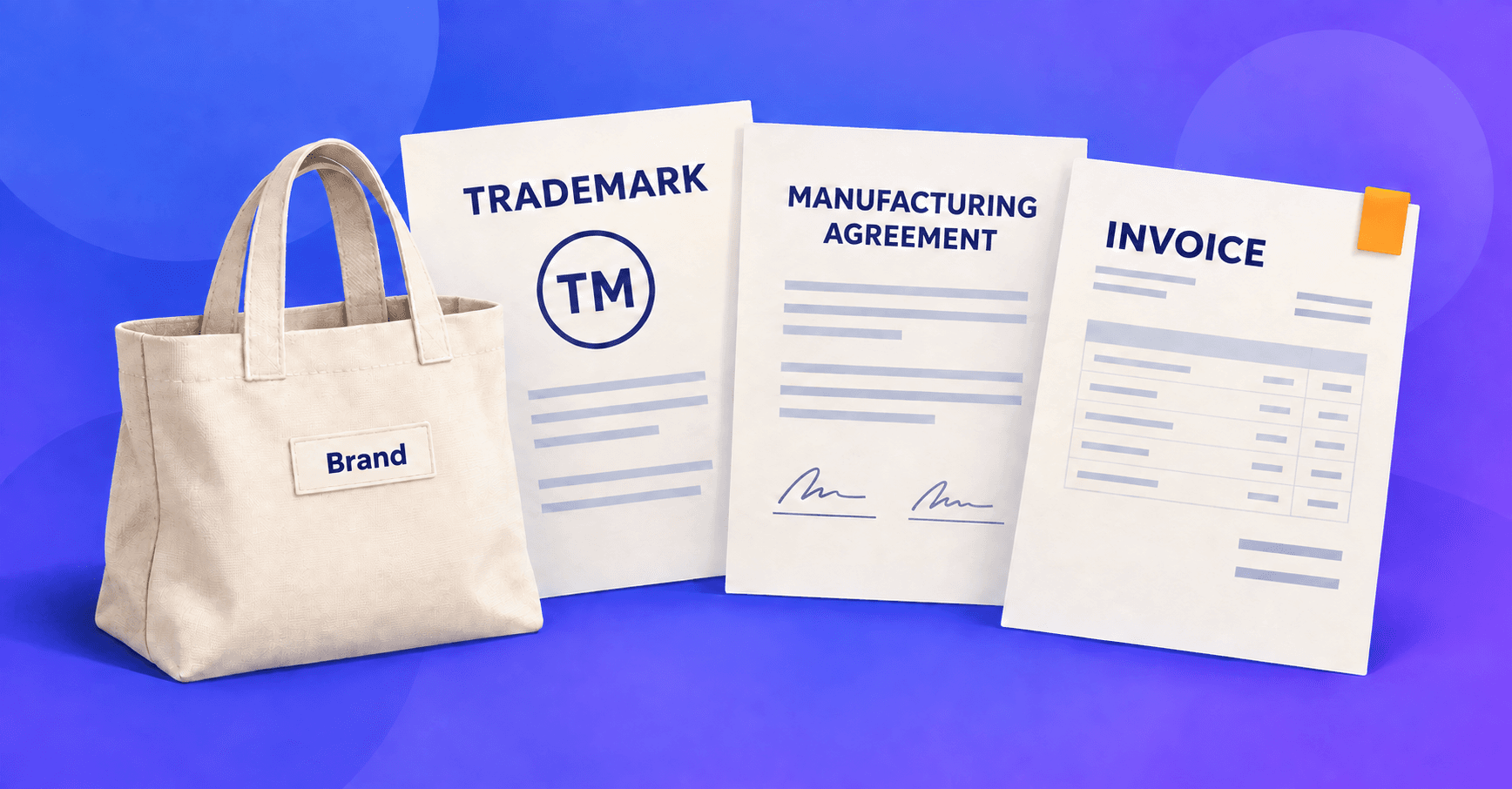
I thought getting ready for Amazon Brand Registry meant two things: file the trademark and take a photograph of the product with the brand name on it.
For my brand, Bexholm, I had done both. I received the US trademark filing receipt on September 8, had the factory produce a branded unit, and submitted the Brand Registry application on September 15.
Then Amazon rejected the invoice I had uploaded. Its message said the document was missing, incomplete, or insufficient to confirm brand association or ownership.
The surprise was how much the application depended on manufacturing paperwork. I had treated the trademark and photograph as the main preparation. The document I supplied for the invoice was actually a purchase order I had issued to the factory.
That raised a bigger question: what should you have ready before applying—and what if you only have a trademark and a branded sample, without a production order yet?
The main documents and information to prepare
For someone preparing to enroll a private-label brand, I would organize the application into these groups. Some are core enrollment information; others depend on the manufacturing arrangement and the requests shown in the application.
| Group | What to prepare | When it matters |
|---|---|---|
| Trademark details | Trademark office, registration or eligible pending-application number, brand text, and mark type. | Core eligibility information. |
| Brand images | Clear photographs of actual products or packaging carrying permanent branding; the matching mark image if applying with a design mark. | Evidence of the physical brand. |
| Applicant details | The trademark owner's information; use the existing Seller/Vendor Central credentials if applicable. | Connects the applicant to the brand. |
| Manufacturing evidence | Documentation of your own manufacturing setup, or an agreement with the third-party manufacturer, as requested. | Depends on how your products are made. |
| Sourcing or supply invoices | Genuine invoices for relevant transactions, with identifiable supplier, purchaser, and products. | Prepare for the invoice request in the application; it was decisive in my case. |
| Supporting information | Product categories, website and distribution information where applicable; relevant existing ASINs if you have them. | Helps describe the business and products. |
Amazon's public enrollment requirements explain the trademark, branding, owner, and account information. Its enrollment walkthrough also says additional manufacturing or distribution evidence may be requested. Those requests are part of completing the application, even when the headline eligibility requirements have already been met.
1. Have the trademark record ready
According to Amazon's trademark requirements, an eligible pending application can be used for enrollment; the trademark does not always need to have reached registration. Check the issuing trademark office and status, then keep the application number, brand wording, and mark type together so the enrollment details agree with the trademark record.
For Bexholm, I applied using a pending US word-mark application. Having that filing ready did not settle the separate questions about the products and supplier.
2. Photograph the real branded product or packaging
Amazon's image guidance says the branding must be permanently affixed to the product or packaging. Its examples include printing, sewing, engraving, and laser etching. A digitally added logo or computer-generated product mockup does not meet the image requirement.
My factory produced a unit carrying the BEXHOLM mark so I could provide actual photographs. For someone at the sample stage, the useful question is whether the physical sample and its branding meet the image rules. That question is separate from whether the rest of the application is complete.
3. Document who makes the products
If a factory makes products for your brand, prepare to explain and document that relationship.
In an Amazon staff explanation of manufacturer evidence, a community manager states that selecting the third-party-manufacturer option requires proof of the arrangement. The explanation describes an agreement identifying the brand and manufacturer, with addresses, contact details, and both parties' signatures.
The manufacturing agreement and invoice answer different questions. The agreement records the relationship under which the factory makes the branded products. The invoice records a transaction. In one enrollment case, an Amazon moderator explained that an invoice submitted in the contract section did not satisfy the contract request.
For my next application review, I would check every upload field and the evidence it asks for, instead of assuming one supplier document covers all of them.
4. Prepare for the invoice request
This was the gap in my preparation. Looking back at my submitted PO, I found:
- I had issued it to the supplier; it was not the supplier's invoice to me.
- It used a PO number and date.
- The buyer information showed the brand name without the legal purchaser's address.
- The item description said “Canvas Tote Bag — Black,” leaving the connection to Bexholm unstated.
These are my findings from reviewing the document. Amazon identified the invoice as insufficient but did not say which individual field caused the rejection.
The practical next step is to obtain the supplier's accurate invoice for the actual transaction and check that it identifies the purchaser, supplier, and goods clearly. Any brand description must reflect what was actually supplied. Renaming a buyer-issued PO does not turn it into a supplier-issued invoice.
Also check the date window in the live application. In a Brand Registry invoice discussion, the request quoted invoices from the last six months, and an Amazon moderator referred the applicant to the manufacturing section of the enrollment guide. My July 21 PO was recent; its age did not resolve the other weaknesses.
Can you enroll before placing a production order?
Not having a bulk production order does not, by itself, establish that you are ineligible. But a trademark and sample photograph do not guarantee you can complete enrollment.
Amazon's enrollment guide explicitly says brands can enroll even if they do not sell in its store. An Amazon moderator also explains that existing ASINs are optional in the relevant application field. So you do not have to assume that you must launch a listing and make Amazon sales first.
That still leaves the manufacturing and invoice evidence. Here is how I would approach three situations:
| Your situation | What to clarify before applying |
|---|---|
| You bought a branded sample from the intended manufacturer, but have not ordered bulk stock. | Obtain the actual sample invoice and document the manufacturing arrangement. Ask Brand Registry Support whether these satisfy your application's requests. |
| You have a prototype or photograph, but no supplier transaction or manufacturing arrangement. | Ask what alternative evidence is accepted for your actual setup. Do not assume the trademark waives a required upload. |
| You manufacture the products yourself. | Use the truthful self-manufacturing option and follow its evidence requests. Ask what records are accepted if you have no finished-goods purchase invoices. |
I found an Amazon staff response to a seller at the sample stage that closely matches the first situation. The seller had a trademark, permanently branded samples, and a supplier ready to begin production. Amazon's moderator identified problems with the manufacturing-agreement evidence and directed the seller to obtain a proper agreement. The reply did not say to place a bulk order first, but it also did not establish that any sample invoice will automatically pass.
I have not found a published universal minimum order quantity for Brand Registry, or a blanket promise that a one-unit sample invoice is sufficient. My interpretation is that a seller should resolve the evidence question before committing to production solely to obtain paperwork.
A focused question to ask support would be:
“I have an eligible trademark application and a physical sample with permanent branding, but I have not placed a bulk production order. What manufacturing and invoice evidence will you accept at this stage? If I provide the genuine sample invoice and a signed agreement with the manufacturer, will those satisfy the requested documents?”
The sample-invoice route is a possibility to verify, rather than a guaranteed workaround. If Amazon requires an invoice and you have neither an acceptable invoice nor an accepted alternative, that missing evidence can prevent completion of the application.
What I would prepare earlier next time
Before applying, I would assemble the trademark details, real branded photographs, and the documents appropriate to my manufacturing setup in one folder. I would read the upload requests while there is still time to obtain missing records from the factory.
For Bexholm, the application is currently rejected and the invoice issue is unresolved. The lesson I can share now is that completing the trademark and product-photo steps did not finish the preparation. The supplier paperwork deserved attention just as early.
If you are still evaluating the product, estimate its Amazon FBA profit alongside the launch preparation. A sample, a workable margin, and an application-ready document set are all useful things to have before committing to a large order.
Sources
- Amazon Brand Registry enrollment requirements
- Amazon Brand Registry enrollment guide
- Amazon staff explanation of manufacturer evidence
- Amazon staff response on invoices and contracts
- Amazon Brand Registry invoice discussion
- Amazon staff response on optional ASINs
- Amazon staff response to a seller at the sample stage